Running a Super League
A Super League (also called "Super N") is one of ServeLeague's most exciting formats. Instead of a single knockout event, players compete across multiple rounds, each round is a full-placement bracket where every participant finishes with a unique position. Points accumulate over the series, and the overall champion is determined by their best scores.
What is the Super League Format?
In a Super League with N players per round:
- Each round is a standalone bracket. All N players are seeded into a knockout bracket with consolation tiers (Cup, Plate, Bowl, Shield), so every player gets a definitive finishing position from 1st to Nth.
- Every player plays the same number of matches. In a Super 16, every player plays exactly 4 matches: losers drop into consolation tiers rather than being eliminated.
- Points are awarded by position. 1st place earns N points, 2nd earns N−1, down to 1 point for last place.
- Overall standings use a "best K of M" rule. Only a player's top K round scores count. This lets players miss a round without being knocked out of contention.
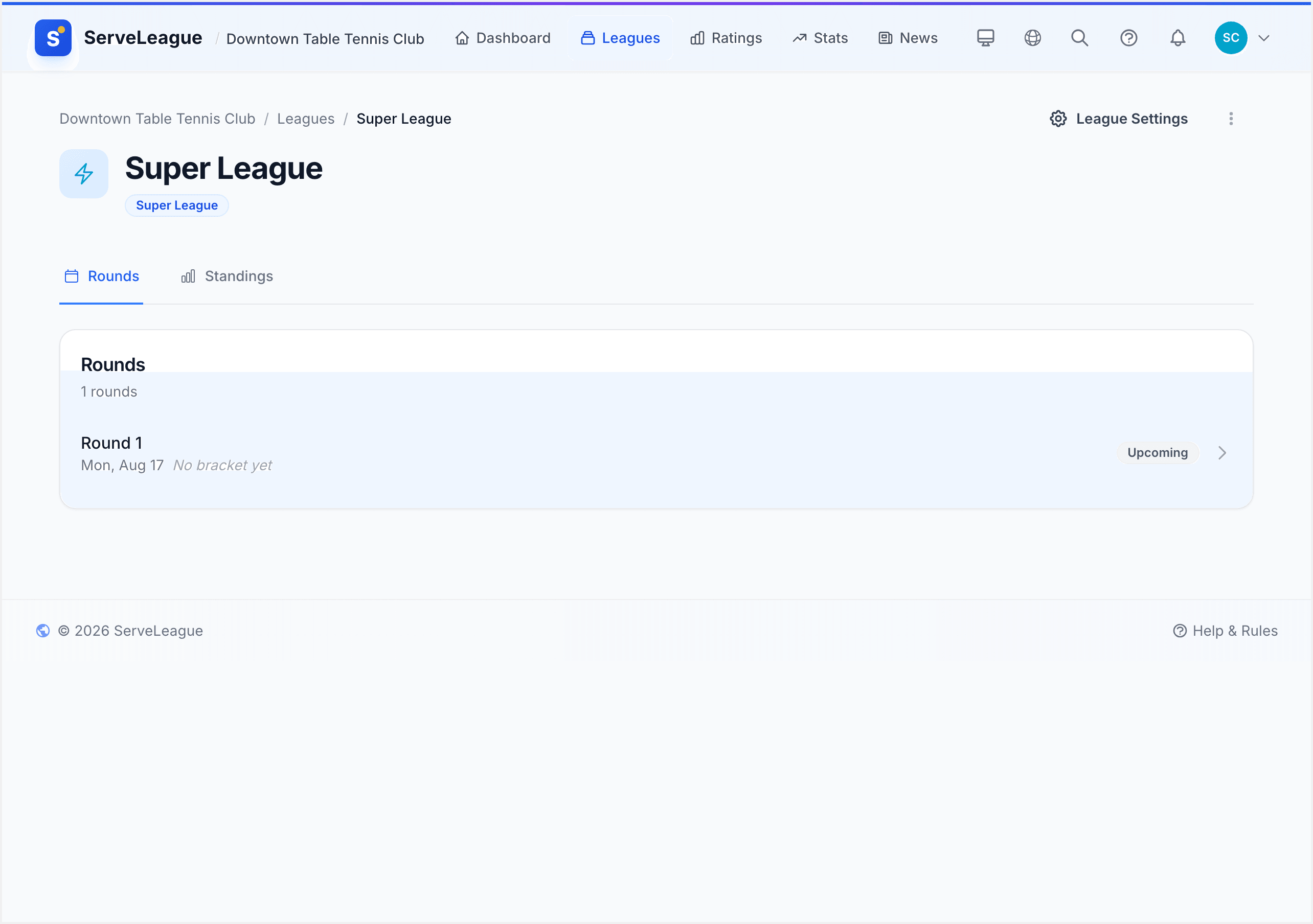
Step 1: Create a Super League
From your club dashboard, go to Leagues and click Create League. Select Super League as the format. The creation wizard walks you through four steps: Basics, Format, Schedule, and Review (see Creating Your First League for general league setup guidance).
Basics
Enter a League name (e.g., "Monday Night Super League" or "Spring Super 16") and an optional Description explaining the format or any house rules.
Format
This is where you configure the core Super League settings:
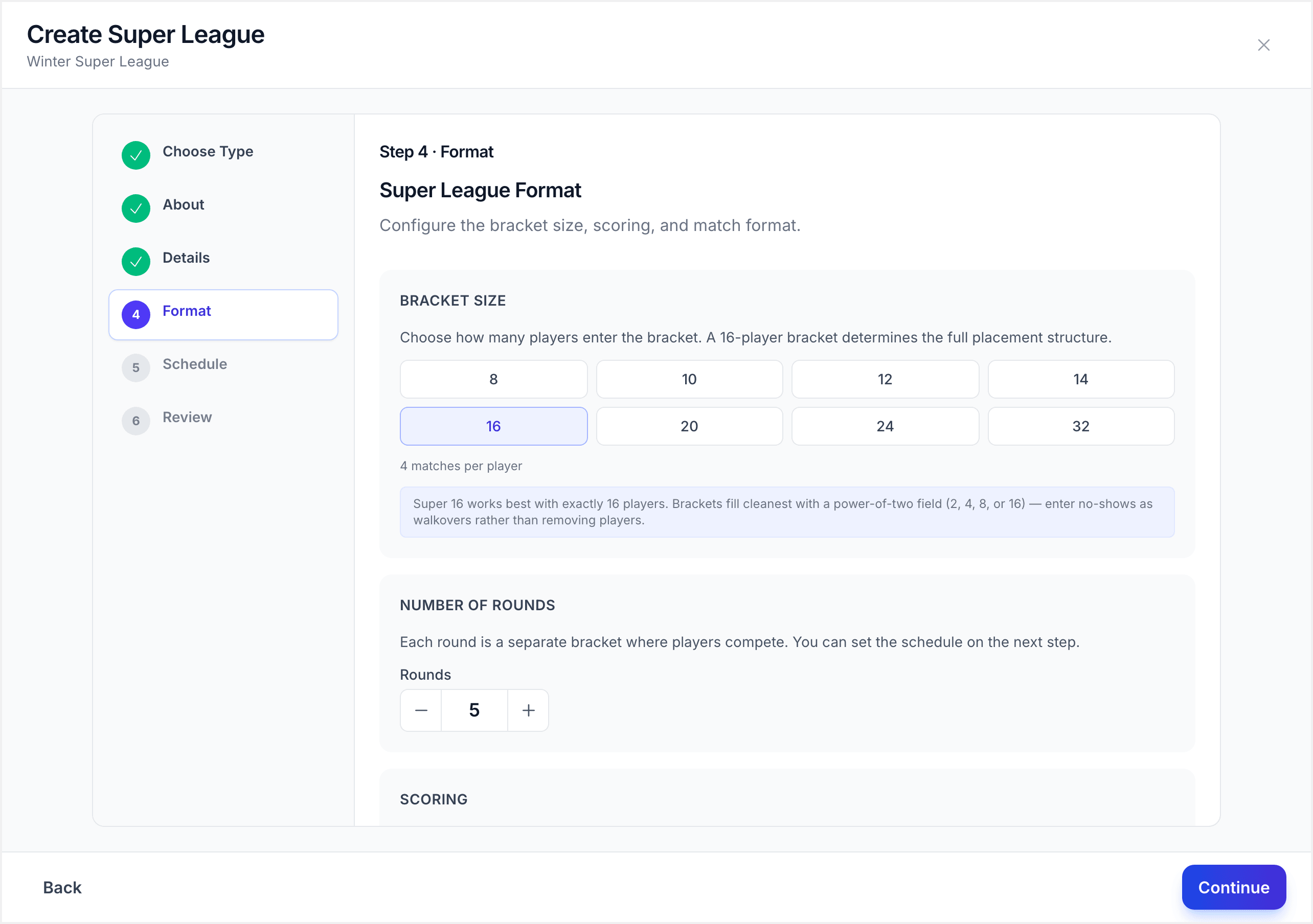
Bracket Size: Choose how many players compete in each round. Available sizes are 8, 10, 12, 14, 16, 20, 24, and 32. The bracket size determines the tier structure:
| Bracket Size | Tiers | Matches per Player |
|---|---|---|
| 8 | Cup, Plate | 3 |
| 16 | Cup, Plate, Bowl, Shield | 4 |
| 32 | 5 tiers | 5 |
Number of Rounds: How many rounds the league will run (e.g., 8 rounds over an 8-week season). You can always add more sessions later.
Best Scores to Count: The K in "best K of M rounds." For example, if you set this to 5 in an 8-round league, each player's top 5 scores determine their overall ranking. This rewards consistency while allowing for missed rounds.
[!TIP] Set the best-of count lower than your total rounds to give players flexibility. A common setup is "best 5 of 8" or "best 6 of 10."
Match Format: Choose how individual bracket matches are played: best of 1, 3, 5, or 7 sets (the available options depend on your club's sport).
Tier Names: Each consolation tier gets a default name (Cup, Plate, Bowl, Shield). You can customise these to match your club's traditions, for example, "Gold", "Silver", "Bronze".
Schedule
Set dates for each round. You can enter specific dates, leave them blank for unscheduled draft sessions, or fill them in later. Each round is named automatically (Round 1, Round 2, etc.) but you can rename them, for instance, "Week 1, 15 Feb" or "Finals Night."
Review
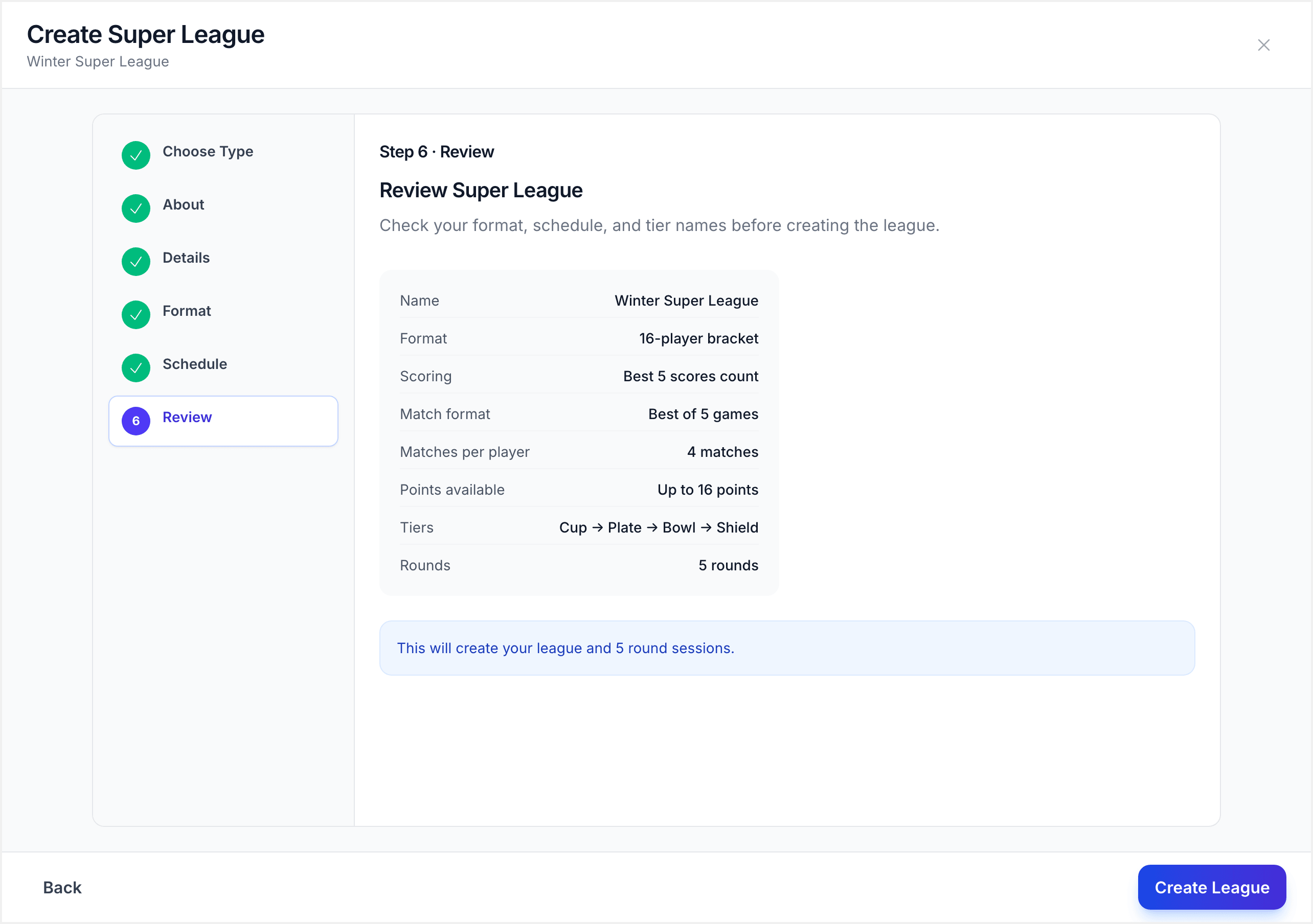
Check your settings and click Create League. ServeLeague creates the league and all its round sessions in one go.
Step 2: Manage Round Registration
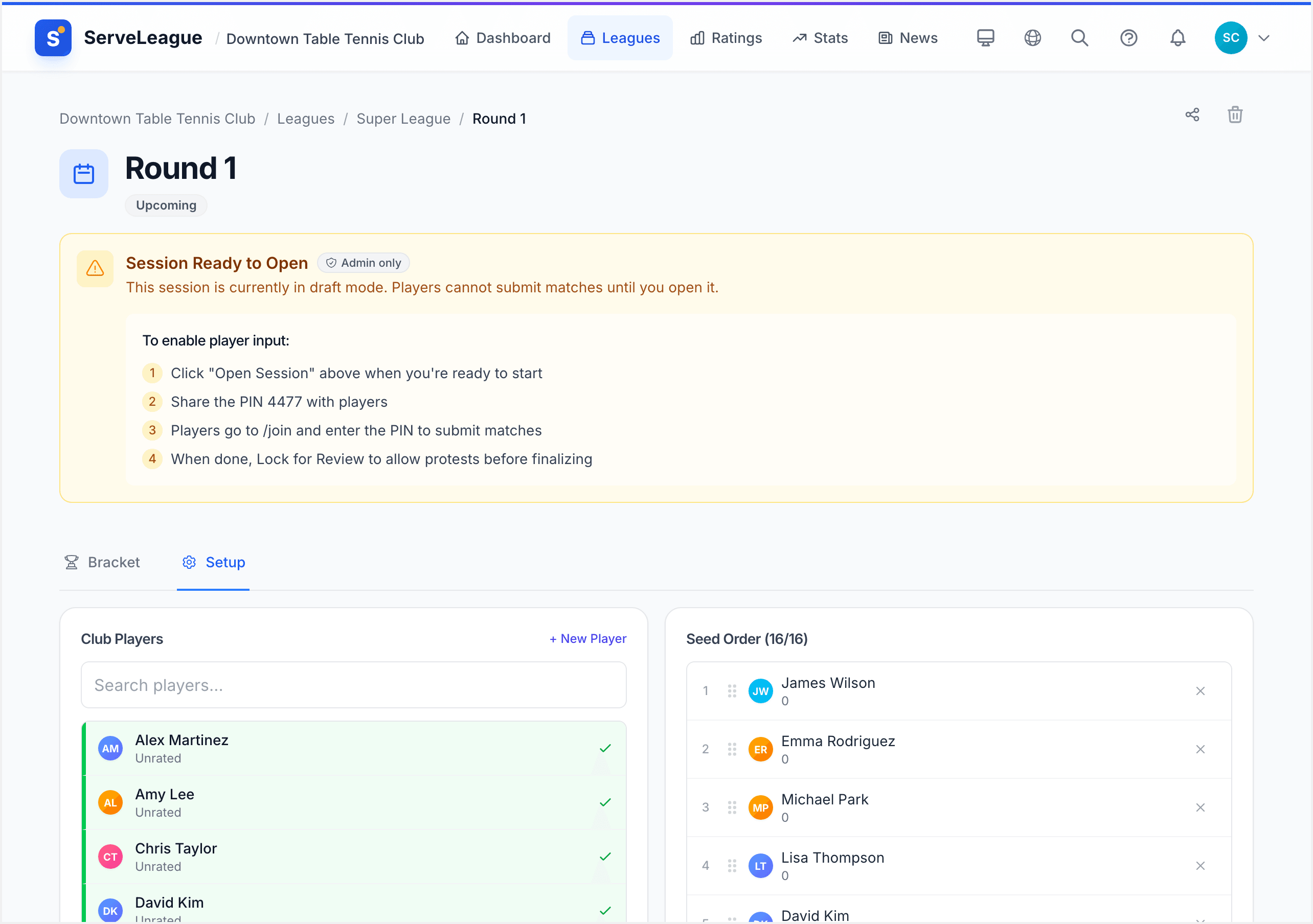
Each round (session) has its own player registration. Before a round can begin, players need to be registered and confirmed.
Registration Flow
- Players register: Players sign up for the round, either through self-registration or added by an admin. Their current rating is captured as a snapshot for seeding purposes.
- Admin confirms entries: The admin confirms the top N players (matching the bracket size). Confirmed players receive seed positions based on their rating. Any extra registered players are moved to a waitlist in case of withdrawals.
- Players can withdraw: If a confirmed player can't make it, they withdraw and a waitlisted player can be promoted.
Step 3: Seed Players and Generate the Bracket
Once entries are confirmed, the next step is seeding.
How Seeding Works
- First round: Players are seeded by rating: highest rated gets seed 1.
- Subsequent rounds: ServeLeague suggests seeds based on rating, with an optional re-seeding rule. If a player finishes two or more seeding brackets above their seed position in the previous round (e.g., a seed 12 finishes 3rd), they get promoted. This keeps the bracket competitive as the series progresses.
The admin can accept the suggested seeds or manually adjust them. Once seeding is confirmed, click Generate Bracket to create the full knockout bracket with all tiers.
Understanding the Bracket Tiers
In a Super 16 bracket, the tiers work as follows:
- Cup (main bracket): All 16 players start here. Standard knockout with 3rd/4th playoff. Determines positions 1–4.
- Plate: The 4 Cup quarter-final losers play a mini-bracket for positions 5–8.
- Bowl: The 8 Cup round-of-16 losers play a full bracket for positions 9–12.
- Shield: The 4 Bowl quarter-final losers play for positions 13–16.
The key insight: losers don't go home, they drop into the next tier. Every player plays the same number of matches and ends up with a definitive finishing position.
Step 4: Play Matches and Enter Scores
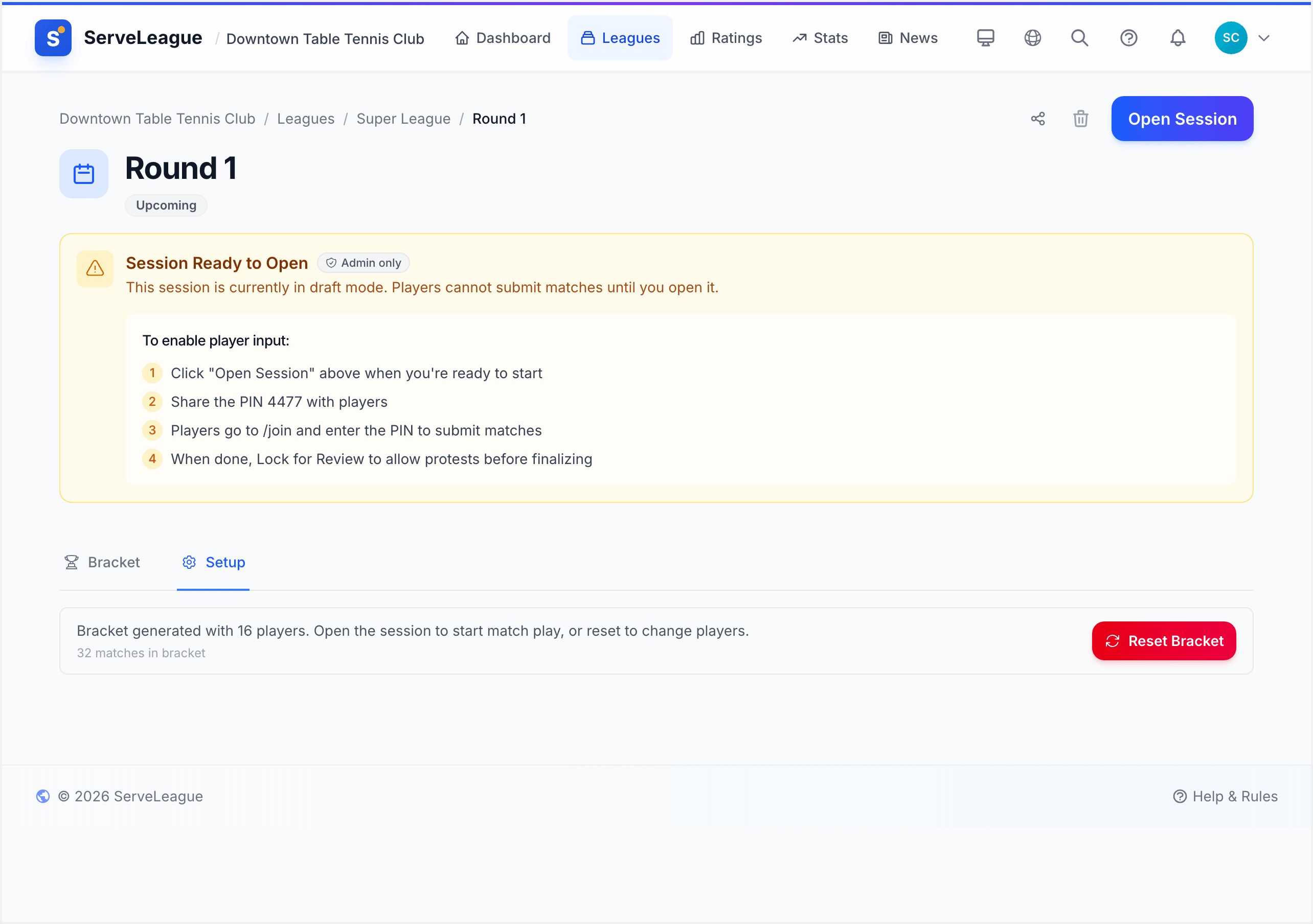
With the bracket generated, it's time to play. The session view shows all bracket tiers in separate tabs.
Entering Results
As each match is played, an admin (or a player with the session PIN, see Score Entry and Match Management) enters the result:
- Click on a match in the bracket
- Enter the set scores
- The winner advances in their tier; the loser drops to the appropriate consolation tier
Matches must be completed in order within each tier, you can't skip ahead. However, different tiers can progress independently.
Step 5: Finalize the Round
Once every bracket match is complete across all tiers, the admin finalizes the round. Finalization:
- Assigns finishing positions: Each player gets a unique position from 1st to Nth based on their bracket results.
- Calculates placement points: 1st place earns N points (e.g., 16 points in a Super 16), last place earns 1 point.
- Updates overall standings: The new round scores are factored into the cumulative leaderboard.
Step 6: Track Overall Standings
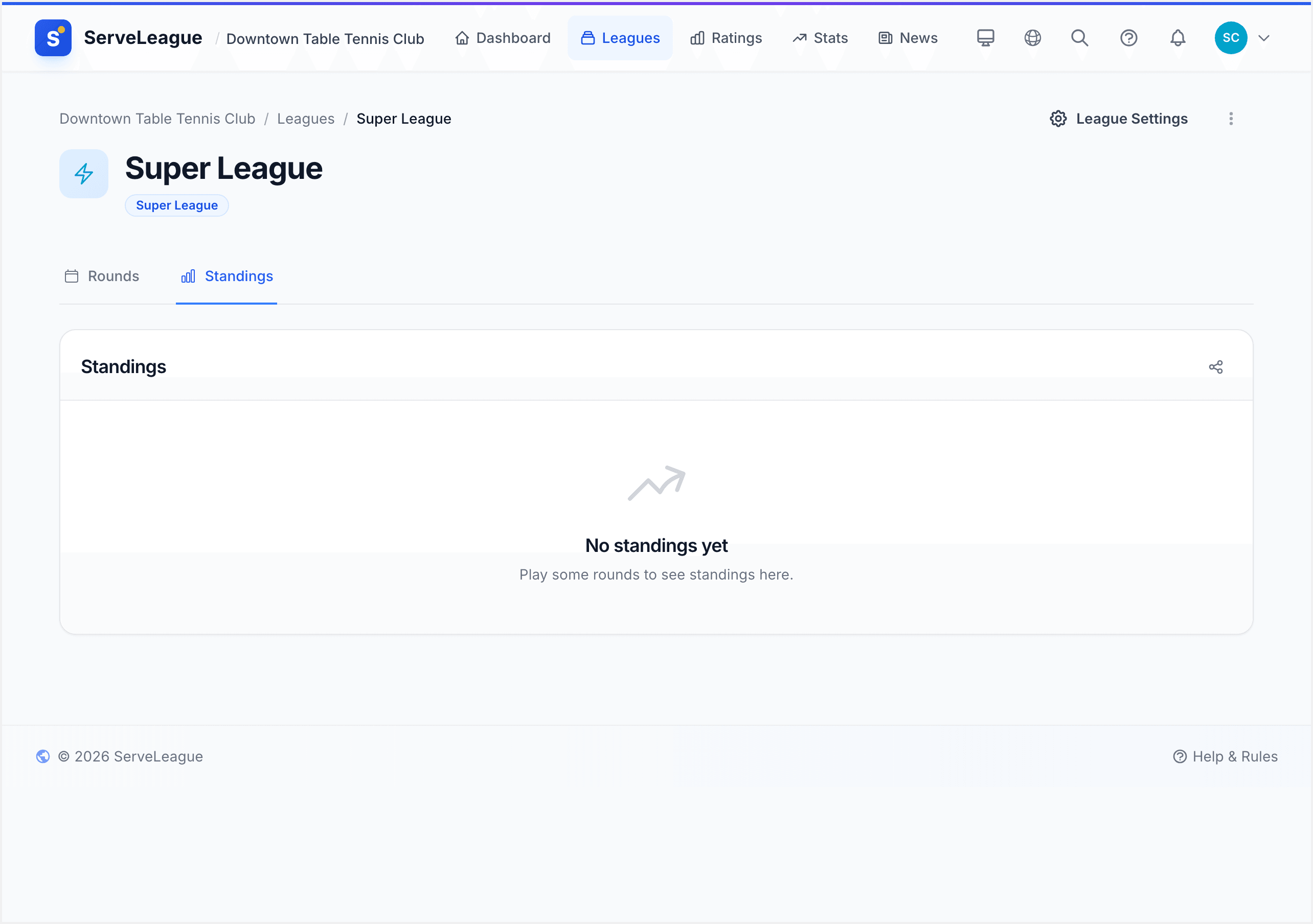
The league standings page shows the running championship table across all completed rounds. For each player you'll see:
- Per-round scores: Points earned in each round, with their best K scores highlighted as "counted" and the rest shown but not included in the total. For deeper analysis, see Statistics and Reports.
- Best K Total: The primary ranking column: the sum of their top K scores.
- Total Points: Sum of all scores (used as a tiebreaker).
- Best Finish: Their highest single-round placement (used as a second tiebreaker).
- Rounds Played: How many rounds they've entered.
Tiebreaking order: Best K Total → Total Points → Best Finish (lowest) → alphabetical.
Tips for Running a Great Super League
- Choose the right bracket size. If you regularly have 12–14 players, a Super 16 works well: two players can be added or swapped between rounds. If attendance varies widely, consider a smaller bracket.
- Use the re-seeding rule. It prevents sandbagging and keeps matchups unpredictable.
- Communicate the best-of rule early. Players should know that missing a round isn't catastrophic: their worst scores will be dropped.
- Name your tiers. Custom tier names ("Champions", "Challengers", "Contenders", "Newcomers") add personality and make consolation rounds feel meaningful.
What's Next?
- Running a Tournament: Learn about single-event tournament formats with group stages and seeded knockout brackets.
- Score Entry and Match Management: Deep dive into entering scores, handling walkovers, and managing match disputes.
- Understanding Your Rating: Learn how Super League matches affect player ratings and what the numbers mean.